September 22, 2026
Member Spotlight: GeneFab
Bridging Design and Delivery
Scientific breakthroughs in cell and gene therapy often capture the spotlight, but translating complex genetic medicines into scalable, clinic-ready therapeutics demands an equally sophisticated manufacturing architecture. GeneFab was founded to meet this challenge by seamlessly integrating synthetic biology design expertise with specialized GMP manufacturing infrastructure.
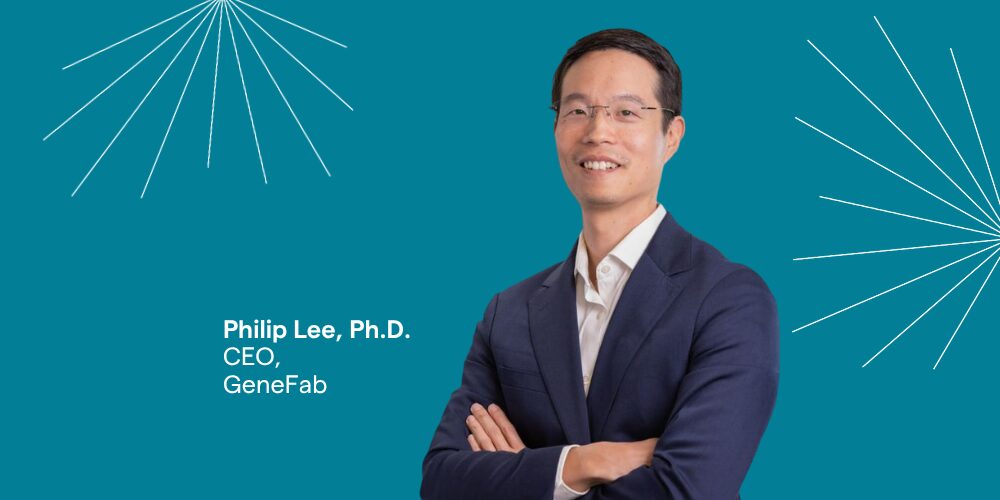
For Chief Executive Officer Philip Lee, PhD, the key to unlocking the full potential of advanced therapies lies in eliminating the traditional disconnect between early-stage therapeutic design and commercial manufacturability. In this month’s member spotlight, Lee shares why early alignment on manufacturing strategy is essential for modern biotechs, how GeneFab is building end-to-end platform solutions for emerging in vivo modalities, and why the future of biomanufacturing relies on bridging the gap between innovative biology and operational precision.
GeneFab was established to address evolving demands in the cell and gene therapy (CGT) sector. What specific market gaps or manufacturing bottlenecks in the traditional CDMO landscape inspired the creation of the company, and how has that initial vision shaped your operating model?
GeneFab was created in 2023 to support manufacturing and technology development of innovative cell and gene therapy products. These modalities are very different from traditional biologic therapies and require specialized technical capabilities and customer focus that we felt were lacking in the CDMO market at the time. As a newer company, we were able to optimize our facility, workforce and services to provide the highest value for our innovative clients.
A key thesis of our approach is that the complexity of genetic medicines requires a close pairing of synthetic biology design expertise with GMP manufacturing infrastructure. Integrating this connection early has become increasingly important over the last few years. Streamlining the fragile handoffs between design, PD/AD and GMP through our integrated capabilities substantially reduces timeline and quality risk inherent in working with multiple outsourced partners.
A common pitfall in CGT development is treating process development and manufacturing strategy as late-stage concerns. Why is it critical for innovators to integrate manufacturing and commercial scalability considerations into their early-stage R&D, and what risks do teams run by delaying this alignment?
The key considerations, in my opinion, are threefold: one, investors now perform diligence on manufacturing at the earliest stages. Simply having scientific (or even clinical) proof of concept is not enough if there is not a clear path to commercial scale.
Two, for genetic medicines, the (sequence) design of the therapy has direct implications on the manufacturability of the product. It is not uncommon to have a prototype that works great in the lab, but it turns out there is no practical way to produce it in GMP to conduct a clinical trial, much less commercial scale.
Three, on the flip side, it doesn’t make sense for innovation teams to heavily invest in manufacturing infrastructure at the early stages of a program. The goal should be finding a CMC partner that can support early-stage projects and scale with success. This allows the same team to flag manufacturability issues during the design stage and translate them to GMP.
As therapeutic modalities grow increasingly complex, synthetic biology tools like genetic circuit design and targeted vector engineering are becoming central to therapy design. How is the integration of synthetic biology redefining what a modern CDMO can contribute to a drug developer’s pipeline beyond standard, fee-for-service manufacturing?
Ten years ago, I became convinced that the trajectory of cell and gene therapies would require the intersection of synthetic biology and manufacturing.
The fundamental change that is occurring in therapeutics is the transition from “finding” to “building”. Take the analogy of the modern houses we live in today. There was a time when our ancestors found shelter by being good at finding caves and other structures that existed in nature. At some point we learned engineering principles and adopted better tools to allow very complex buildings to be regularly designed and constructed. This is the type of transformation that is possible as synthetic biology and biomanufacturing continue to advance.
Extending that analogy, I see a modern CDMO acting as a design consultant, architect and project manager, in addition to doing the contract labor. By understanding each step of the process, the overall product is better from start to finish. For clients, that means fewer surprises. With design, process development and GMP manufacturing under one supplier, there are no handoffs where knowledge or accountability falls through the cracks.
Emerging cell and gene therapy companies often face steep learning curves when transitioning from academic or bench-scale discovery to IND-enabling studies. In your experience, what critical operational or analytical factors do early-stage biotechs most frequently underestimate during this clinical transition?
When you are in research, the formula to success is to move quickly and “try everything”. This strategy becomes counterproductive when translating to manufacturing, and that is a big shock to many people.
The best advice I have for innovator teams is to define success criteria upfront with as much specificity as possible. CMC teams are usually very good at meeting defined targets, but if the targets are poorly defined or changing constantly, the timelines and costs expand exponentially. A CMC partner engaged from bench through IND helps you shape those criteria upfront rather than inheriting them cold at tech transfer, strengthening your program instead of stalling it.
Another area that is often underestimated is clearly understanding your product-specific potency assays. These are unique to your product, and the more detail and historical data you can bring to your CMC partner the better. Too often I’ve seen developers assume “it’s such an easy assay” only to see it become the rate-limiting step of the entire clinical project.
The field is rapidly advancing toward next-generation in vivo cell and gene therapies. What unique technical, regulatory, and scale-up challenges will these in vivo modalities demand from CDMO infrastructure compared to traditional ex vivo approaches?
The in vivo modality is incredibly exciting and I see tremendous potential for it to address key CGT accessibility bottlenecks. From a manufacturing perspective, safety is paramount—the vectors need to be designed to specifically express the gene of interest in only the target cells. And the manufacturing process needs to be stringent to remove impurities, which can lead to immune reactions and toxicity. Legacy ex vivo vector processes don’t address these issues, so it is important for a CDMO to re-establish its unit operations and analytical strategy to meet the required product quality targets.
GeneFab has developed, from the ground up, an in vivo platform solution that leverages our expertise in synthetic biology, process development, analytical development and manufacturing. This platform ensures cell type specific targeting and gene expression in a manufacturing process that minimizes impurities and tech transfer time. This allows our clients to plug in their unique gene constructs and get to GMP faster and more cost efficiently.
Operating within the San Francisco Bay Area places you at the heart of a highly concentrated biotech innovation cluster. Why does the Bay Area remain such a vital ecosystem for advanced therapies, and how does proximity to local biotechs impact speed, collaboration and tech transfer?
For innovative medicines, flexibility and the ability to adapt quickly are major competitive advantages. Being local (both geographically and philosophically) has helped us build strong relationships with the Bay Area and West Coast biotech ecosystems. This allows us to quickly solve process issues, complete tech transfer steps in days rather than weeks, and to bring the right people into the room to make time-sensitive decisions.
CDMO selection in CGT is not a “check the box” exercise. Often, the relationship starts very early on (while products are still being defined) and a partner’s ability to demonstrate an understanding of client needs far in advance of a contract being signed is important. We routinely help clients by making introductions to potential investors and industry collaborators. Having been in the shoes of our clients ourselves, we know a successful therapy needs a partner that is more than just transactional.
Looking ahead at the broader CGT market, what macro trends, clinical breakthroughs, or technological shifts are you most excited about, and how is GeneFab positioning itself to support the next era of advanced medicines?
The rapid progress of in vivo cell therapies is very exciting. Innovative products and emerging clinical data related to engineered viral vectors and non-viral RNA/LNP systems have the potential to significantly improve accessibility to complex therapies. I am very optimistic about the application of physical AI to biomanufacturing. Robotic systems and LLMs are getting to a point where they can learn and adapt to variability, which is the biggest hurdle to automating biology. This should enable improved product quality, reduced turnaround times, and lower costs of manufacturing. Staying on top of these trends requires an end-to-end framework from design to GMP so developers can bring their gene of interest and seamlessly transition to clinical production. Enhancing facilities and quality systems with the latest technologies will be critical as the industry prepares for the growing wave of FDA commercial approvals.
Lastly, drawing from your extensive background as both an entrepreneur and a biotech leader, what advice would you offer to young professionals preparing to enter the life sciences industry today?
It is the best time in history to enter the life sciences industry. The pace of progress is astounding, and the potential impact you can make is humbling. My best advice is to maintain a learning mindset. Biotechnology has historically been a very siloed industry where it was possible to only be “good at one thing.” That is no longer the case, and that’s a good thing. The more you can expose yourself to the different aspects of the industry, the more valuable you will be as an employee and leader.