January 29, 2026
Member Spotlight: Rosebud Biosciences
Starting Drug Discovery in Human Systems for Rare Disease
Drug discovery—particularly in pediatric rare diseases—faces steep challenges: small patient populations, limited genetic models, and persistent gaps between preclinical results and clinical reality. Rosebud Biosciences was founded to address these challenges head-on by rethinking how human biology is modeled earlier in drug development.
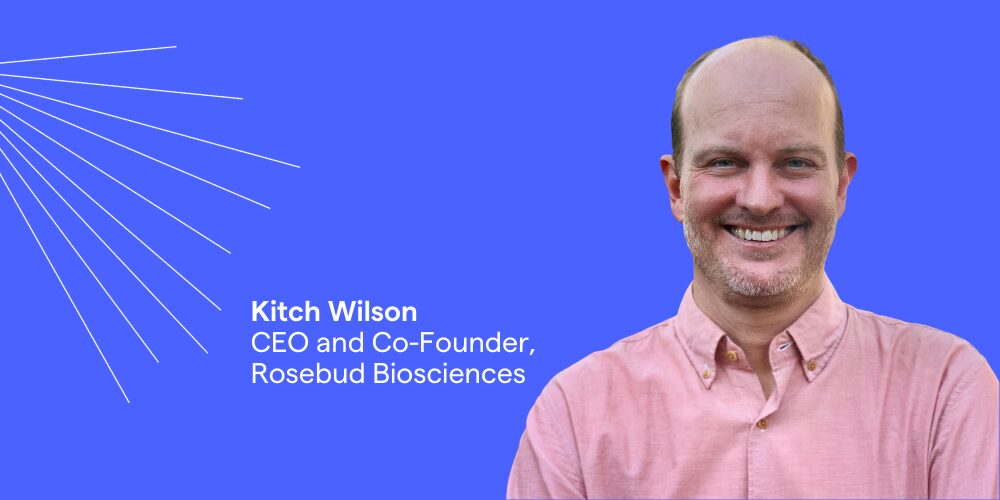
Led by CEO and Co-Founder Kitch Wilson, Rosebud is building scalable, automated organoid systems designed to generate human-relevant, clinically meaningful data—earlier, faster, and at scale. In the member spotlight below, Wilson shares how Rosebud’s human-first approach is reshaping disease modeling, safety assessment, and drug development decision-making.
Pediatric rare disease therapeutics presents unique scientific and clinical challenges. What drew you to this space, and how does that responsibility shape Rosebud’s mission?
We founded Rosebud on the core belief that drug discovery should be developed in human systems first, with animal models used for validation rather than discovery. Pediatric rare diseases were a natural starting point because hiPSC-derived cells and tissues are developmentally immature and ideally suited for modeling developmental disorders.
While this is technically true, hiPSC-based systems are surprisingly able to model aspects of later-life diseases, including neurodegeneration. At the same time, the challenges we observed in pediatric drug development—limited genetic models, poor translational fidelity, and toxicity—were not unique. They also affected adult diseases, often on a much larger scale. That realization has continued to shape both our mission and our long-term strategy.
Can you walk us through how the organoid platform works in practice, and why this approach may outperform traditional models?
We begin with hiPSCs, which can be reprogrammed directly from patients or engineered with disease-causing mutations. Automated workflows then differentiate these cells into tissue-specific organoids that enable high-throughput drug exposure, longitudinal monitoring, and multimodal data collection. These data are processed through our AI-driven analytics to extract biologically and clinically meaningful signals.
This approach outperforms traditional models because it preserves human-specific tissue biology and allows experiments to be parallelized across multiple organ systems. Importantly, we founded Rosebud to industrialize organoids. Early organoid systems were difficult to reproduce, expensive, and highly dependent on technician labor. We intentionally moved away from suspended spheroid formats and developed hiPSC micropatterns that remain attached to the culture plate. This ensures fixed geometries, avoids necrotic cores, supports longitudinal imaging, and allows robotics to manage the workflow end-to-end—transforming organoids into a scalable, AI-driven data stream.
Over the past year, Rosebud has expanded beyond pediatric rare diseases into broader genetic diseases. What drove that evolution?
As our platform matured and expanded to heart, liver, and kidney models, it became clear that the same biological and translational challenges we saw in pediatric drug development—poor predictive fidelity and toxicity risk—were just as prevalent in adult diseases.
In parallel, we were constantly looking for new and meaningful applications of organoid models. Expanding into broader genetic diseases was a natural extension of our mission. It allows us to apply the same human-relevant, disease-informed biology to larger therapeutic areas while staying deeply aligned with our core platform: scalable, predictive, automated organoid systems that generate clinically meaningful data earlier in development.
Off-target toxicity is a major cause of oncology trial failure. How does Rosebud’s platform address this challenge?
Off-target toxicities are the second leading cause of oncology drug trial failures, costing pharma nearly $20 billion annually and, more importantly, leaving some patients with debilitating or even fatal side effects. A major issue is that traditional preclinical models often miss subtle, cumulative, or human-specific toxicities.
Our platform is an industrialized New Approach Methodology (NAM)—a term used by the FDA and NIH to describe human-relevant, non-animal testing approaches designed to improve predictive safety while reducing reliance on animal studies. Because our system is automated, we can run up to 10,000 parallel drug-dose experiments across cardiac, hepatic, renal, and soon neural organoids while collecting functional data over time rather than relying on single end points.
By identifying these liabilities earlier, drug developers can refine compounds, adjust dosing strategies, or deprioritize risky candidates long before entering costly clinical trials. Ultimately, this has the potential to reduce late-stage failures, improve patient safety, and accelerate the delivery of effective cancer therapies.
Rosebud has announced progress on cardiac, hepatic, and kidney models, with neural organoids underway. How do you decide which organ systems to prioritize?
With our core platform in place, we believe we can automate nearly any organoid tissue as long as a viable differentiation protocol exists. That said, as an early-stage company we need to be strategic.
Our selection criteria balance disease burden, dose-limiting toxicities, and whether improved prediction can meaningfully change drug development outcomes. We also assess whether an organ can be accurately derived from hiPSCs and whether that process is robust enough for automation. Many published protocols are simply too finicky to translate into real-world workflows.
Some insights we’ve gained so far include the observation that kidney proximal tubules are often the first tissue affected by toxic drugs, and that dilated cardiomyopathy organoids consistently shrink in size across different genetic mutations. We’re also beginning to vascularize organoids, which will help us better recapitulate native tissue biology and model vascular pathologies.
Patient engagement is critical in rare disease research. How does Rosebud incorporate patient perspectives into its work?
Before Rosebud, I worked as a molecular pathologist at a major academic hospital, where I routinely encountered patients across the full spectrum of genetic disease. Meeting these patients—especially children—was humbling. Despite advances in targeted therapies, most patients still lack effective treatments and face shortened, painful lives.
That experience was the emotional impetus behind Rosebud. Our name is a reference to Citizen Kane and the snow sled “Rosebud,” symbolizing a childhood derailed by forces outside one’s control—a reality many patients face.
We actively engage patient advocacy groups, clinicians, and foundations to inform disease prioritization and experimental design. These conversations shape our focus on clinically meaningful endpoints—not just whether a drug works in a dish, but whether it improves outcomes patients actually care about. One pilot project we’re especially excited about explores personalized off-target toxicity prediction using a cancer patient’s own hiPSCs to model their organs.
Can you share an example where Rosebud’s organoid models revealed insights traditional preclinical models might have missed?
Mouse models exist for many human genetic diseases, but they often fail to fully reproduce human phenotypes because the downstream consequences of genetic mutations can differ substantially between species.
One example is Alagille syndrome, a pediatric liver disease most commonly caused by mutations in JAG1. While mouse models show mild or no liver phenotype, a third of affected patients ultimately require liver transplantation. By engineering JAG1 mutations into human iPSCs and differentiating them into liver organoids, we observed clear bile duct loss that closely mirrors human disease.
Another example is Fabry disease, a lysosomal storage disorder caused by deficiency of α-galactosidase A. Although mouse models exist, they fail to show significant Gb3 accumulation in the kidney. In contrast, human iPSC-derived kidney organoids display robust Gb3 buildup, revealing disease biology that animal models miss.
As a small but specialized team, how have collaborations accelerated Rosebud’s progress? What do you look for in a partner?
As a small team, partnerships are essential to how we scale both our science and our impact. We collaborate with a range of partners, including a major iPSC services CRO, large pharmaceutical companies, mid-sized biotechs, and oncology-focused therapeutics developers.
These collaborations allow us to validate our automated organoid systems against real-world use cases rather than purely academic benchmarks. Most recently, we partnered with iXCells Biotechnologies, under which Rosebud will serve as the exclusive provider of organoid services—integrating our platform into established, scalable cell service workflows.
We look for partners who value rigor, transparency, and execution, and who recognize that the next generation of organoids must be engineered, standardized systems capable of supporting real drug development decisions.
How do you define success at Rosebud Biosciences, both internally and in terms of broader impact?
We measure success at two levels. Internally, it means building a platform that scales—expanding our organoid portfolio, increasing automated throughput while maintaining reproducibility, and refining our AI-driven analytics to extract more biological signal with fewer assays.
Externally, success is defined by adoption and influence. When our models help drug developers identify safer compounds earlier, deprioritize risky programs, or reduce reliance on less predictive animal or legacy in vitro models, we know we’re having an impact.
Ultimately, our goal is to improve patient safety and accelerate access to effective therapies by making human-relevant, NAM-aligned models practical at scale.
Lastly, what advice would you offer to young people preparing to enter the life sciences industry today?
Stay curious. Biology remains one of the most complex and least fully understood sciences, and that uncertainty is not a weakness—it’s an opportunity. Advances in measurement, automation, and data generation are beginning to illuminate patterns that were previously invisible.
Just as importantly, seek mentors and collaborators who value rigor, integrity, and real-world impact over hype. The convergence of biology and AI is creating unprecedented possibilities, and meaningful progress will require diverse skill sets, high-quality human data, and a deep respect for patients.
Drug discovery should start in human systems, with animal models used for validation—not discovery.