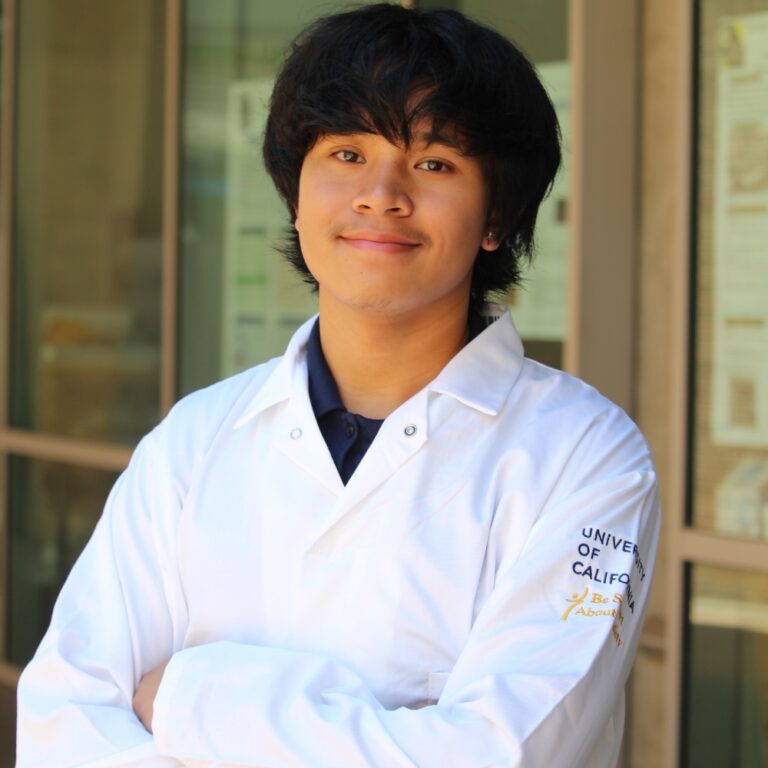
Poster #062, University of California, Riverside
Stem Cell Derived Airway Tissue: A New Approach Methodology to Evaluate Changes Induced by Aerosols
Mentors: Rattapol (George) Phandthong, PhD; Roberto Gonzalez PI: Prue Talbot
Airway basal stem cells are self-renewing stem cells that maintain and repair the tracheobronchial epithelium. Using donor derived airway basal stem cells, we developed the hTET-AIR (human tracheobronchial epithelial tissue-Airway Injury and Remodeling) New Approach Methodology to evaluate pathological changes after aerosol exposure. Previous hTET-AIR studies showed that repeated electronic cigarette (EC) aerosol exposure induces remodeling toward squamous metaplasia. Proteomic analysis also revealed increased cell-to-cell communication pathways associated with extracellular vesicles (EVs), suggesting that EV release may provide an early indicator of epithelial injury before overt remodeling develops. As an initial step toward incorporating EV analysis into hTET-AIR, this pilot study evaluated EV release following exposure to Vuse Alto aerosol extract. Human bronchial epithelial cells (BEAS-2B) were selected for method development because they proliferate rapidly, allowing optimization and data collection before transitioning to stem cell-derived tissues. Cells were exposed to control medium or aerosol extract at 0.001 or 0.01 total puff equivalents (TPE) for 24 or 48 hours. These concentrations produced nicotine levels in the nanomolar range, comparable to concentrations reported in cigarette smokers and EC users. Conditioned media were analyzed by NanoSight nanoparticle tracking analysis to quantify EV concentration and size distribution. At 24 hours, 0.01 TPE significantly increased EV concentration. At 48 hours, EV concentration increased significantly at both concentrations, indicating that longer exposure increased EV release and that the higher concentration produced an earlier response.These findings establish EV analysis as a feasible, exposure-responsive endpoint. Future studies will evaluate EV concentration, size distribution, and molecular cargo in airway basal stem cell-derived tissues exposed at the air-liquid interface. Integrating EV analysis into hTET-AIR may identify early signaling changes that precede goblet cell hyperplasia and squamous metaplasia and expand the platform for evaluating inhaled drugs, and early predictors for pathological remodeling.