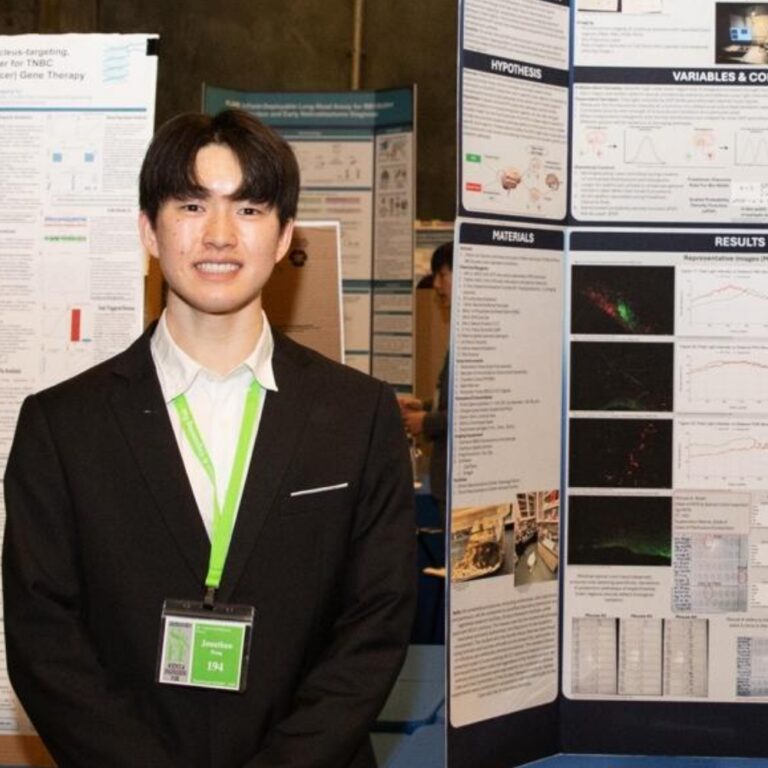
Poster #099, Sanford Burnham Prebys
Molecular Tools to Identify Kv1 Channel Stoichiometry in iPSC Neurons
Mentors: Shengjie Feng, PhD; Yun Ma, BS; Yuliang Han, MS; Alexandra Houser, PhD
It is not only important for neurons to generate electrical signals, but also to subsequently return to their resting state. Voltage-gated potassium channels (Kv) regulate neuronal excitability by controlling membrane repolarization following action potentials. Functional Kv1 channels in the CNS are tetramers composed of four α-subunits (Kv1.1-Kv1.6). Different α-subunit composition and arrangement (stoichiometries) produce channels with distinct electrophysiological properties. Alterations in composition have been implicated in severe neurological diseases.
Although several Kv1 channel structures have been characterized in vitro, those structures are primarily of homomeric channels. Native Kv1 channels predominantly exist as heteromeric channels, and their stoichiometry remains largely unknown. Determining the native stoichiometry of Kv1 channels will improve our understanding of how these channels function differently under healthy and disease conditions, enhancing potential treatments and understanding of diseases.
The project aims to develop and validate molecular tools that will enable future determination of native Kv1 channel stoichiometry in induced pluripotent stem cell (iPSC)-derived neurons and disease models.
Three complementary approaches were pursued. First, Kv1.1-Kv1.4 and Caspr antibodies were evaluated in wild-type mouse cerebellum to validate subunit-specific localization. Second, AI-designed protein binders were assessed for binding to purified recombinant Kv1.1 using fluorescent size exclusion chromatography (FSEC). Lastly, recombinant human Kv1.1-Kv1.6 plasmids were synthesized by replacing the mouse KCNA1-6 coding sequence with the human ortholog.
Future studies will test binders against recombinant human Kv1 α-subunit complexes to assess cross-species binding conservation and applied to iPSC-derived neurons, enabling structural imaging techniques to determine native Kv1 channel stoichiometry in healthy and diseased heteromic assemblies.”