May 27, 2026
Member Spotlight: GATC Health
Building a Biological Intelligence Layer for Drug Discovery
Drug discovery has long relied on a foundational assumption: that animal models and computational correlations are sufficient proxies for understanding human disease. GATC Health was founded to challenge that assumption directly. By building Operon, a systems-scale AI platform grounded in human-derived biological data, the company is pursuing a new model of therapeutic development that evaluates multi-omic interactions before costly wet-lab work begins.
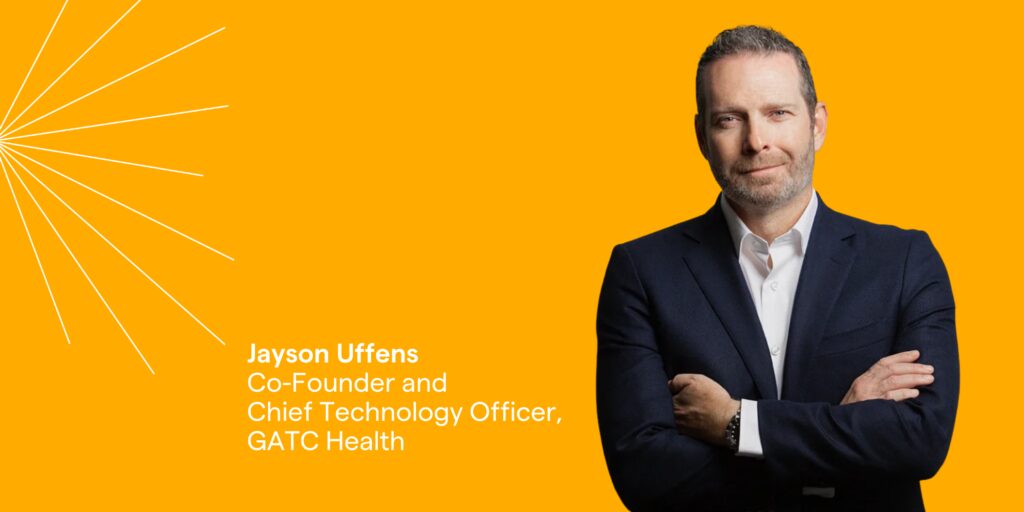
As co-founder and chief technology officer, Jayson Uffens sits at the intersection of AI systems design, biological modeling and real-world therapeutic development. His role is not traditional software engineering but rather bridging Operon’s outputs into real drug discovery workflows, from human tissue data and target identification to candidate design and external preclinical validation. In this month’s member spotlight, Uffens discusses what it means to treat drug discovery as a software problem, why human data changes everything and what it will take to make AI a standard part of how serious therapeutic programs are built.
GATC Health describes itself as a “Tech-Bio” company rather than a traditional biotech. From a CTO’s perspective, how does this distinction change your approach to drug discovery and risk assessment?
Traditional biotech starts with biology and layers technology on top. We invert that. Operon is the foundation, purpose-built to model human biology at systems scale, and all discovery is derived from it. That inversion changes the risk profile in a meaningful way because software iteration cycles are fast and low-cost, and we apply that discipline to biological hypotheses before expensive wet-lab work begins. We treat drug discovery more like a software architecture problem: design, test, refactor, but with the rigor the FDA expects. The “Tech-Bio” label also signals something important about what we are not doing. We are not using AI as a bolt-on tool layered onto existing workflows. In software, failing fast is a feature. In biotech, we use Operon to compress the number of costly failures before they ever reach clinical trials.
The Operon platform is the engine behind GATC’s work. Can you explain, in plain terms, how simulating human biochemistry and multi-omics interactions differ from standard “Big Data” approaches in pharma?
Most big data approaches in pharma are fundamentally pattern-matching engines that look for correlations in large datasets without necessarily understanding why those correlations exist. Operon is designed to move past pattern matching toward biological reasoning. It models human biology and predicts downstream therapeutic efficacy and safety, rather than simply identifying statistical associations.
This distinction matters in practice. We analyze genomic, transcriptomic, proteomic and other data simultaneously rather than in silos, because diseases like opioid use disorder are not caused by a single gene or pathway. They emerge from the interaction of many biological systems at once. In our OUD program, a standard screening approach might begin with roughly 50 compounds to evaluate. Operon’s reasoning narrowed that field to two high-conviction candidates. That is the difference between a database search and a biological intelligence layer.
GATC has reported 91% specificity and 86% sensitivity in predicting drug performance. How does Operon achieve that level of accuracy when modeling the complexity of the human body?
High accuracy requires modeling human biology directly rather than through proxies. We ground the platform in human-derived data from the outset rather than relying on animal models or abstract computational associations. In our OUD program, we began with postmortem human brain tissue samples, which gave Operon a direct window into the molecular signatures of the disease as it appears in people, not in model organisms.
From there, the platform layers multi-omics signals across pathways and disease biology together rather than independently, and that integration catches interactions that single-target or single-omic approaches miss. Operon is also designed for mechanistic grounding, meaning it is not simply finding correlations with an outcome but reasoning about why a particular biological configuration predicts a therapeutic result. When we move into preclinical testing as a result, we are not running broad screens. We are validating specific, well-reasoned hypotheses, and that is why the hit rate is high.
As a co-founder and CTO, how do you balance the rapid “fail fast” culture of software engineering with the high-stakes, highly regulated world of biotechnology?
These cultures are less incompatible than they appear. The important distinction is knowing where rapid iteration belongs and where regulatory discipline is non-negotiable. “Fail fast” in our context means failing computationally and early, before costly experiments, not cutting corners in the lab or clinic. Operon compresses the early-stage search space dramatically, allowing us to iterate rapidly through thousands of hypotheses in silico so that the candidates we bring into the lab are already high-conviction.
Once a candidate enters regulated development, including IND-enabling toxicology, GMP manufacturing and clinical trials, we shift fully into FDA-grade discipline. That is non-negotiable and is built into our workflows from the beginning. We built this company knowing that speed in discovery must be paired with integrity in development. Shortcuts in the validation phase do not save time. They destroy programs and trust.
Your Derisq AI Report is being used as a financial and strategic decision-support tool. How does it help biopharma leaders move beyond one-off AI experiments toward a scalable model?
The challenge in biopharma AI today is that most organizations are running isolated experiments, a single pilot here or a vendor proof-of-concept there, with no systematic way to connect those signals to actual business decisions. Derisq is designed as a decision-support infrastructure rather than a one-time analysis. It gives leadership a repeatable, structured way to assess drug candidates against a consistent AI-powered framework.
It also translates Operon’s biological reasoning into financial and strategic language that executives and investors can act on, bridging the gap between what the AI identified and what that means for pipeline strategy and capital allocation. By standardizing how AI insights are captured, scored and communicated across programs, Derisq creates an audit trail and a learning loop where each use makes the framework stronger. The goal is to shift AI from a novelty or a black box to a standard part of portfolio decision-making: repeatable, interpretable and tied to measurable outcomes.
You’ve described AI as a “force multiplier” for expert teams. How do you see the role of the human scientist evolving as GATC’s predictive models become more integrated into the R&D lifecycle?
AI does not replace scientists. It elevates what they can focus on. The scientist’s role shifts from executing exploratory searches and running many experiments to see what sticks, toward interpreting and directing, spending more time on the hardest biological questions that still require human judgment.
In our OUD collaboration, Dr. Christie Fowler’s team at UC Irvine did not have to run 50 experiments. They ran two, and they could put far more intellectual energy into understanding why the results looked the way they did. The human scientist also becomes the critical validator in this model. AI generates hypotheses; scientists stress-test them, identify where the model assumptions break down, and bring in contextual judgment the platform cannot replicate. Longer term, I see scientists and AI systems working in a genuine feedback loop where scientists refine the biological priors, AI expands the search space and each iteration improves both.
GATC is working to identify distinct disease subtypes in conditions like ALS and opioid use disorder. Why is a multi-omics approach particularly suited to these kinds of “non-obvious” challenges?
Complex diseases like OUD and ALS are not caused by a single broken gene or receptor. They emerge from the dysregulation of multiple interacting biological systems simultaneously, and a single-omic approach gives you only one lens on a multi-dimensional problem. You see part of the picture but miss the interactions that are often where the disease actually lives.
In our OUD research, human brain tissue data did not point to a single clean target. It revealed patterns across multiple pathways, and it was only by reasoning across those layers together that we identified the serotonin receptor combination that became GATC-1021. Multi-omics is also essential for finding subtypes within diseases that look clinically similar but are biologically distinct, which is critical for ALS, where patients sharing the same diagnosis may have very different underlying drivers and therefore need different treatments. The complexity of these challenges is precisely why they have resisted conventional drug development. You need a platform that can hold that complexity and reason across it rather than reduce it prematurely to a single target.
How do you measure success at GATC Health, both in terms of company milestones and the broader impact on human health?
On the company side, milestones matter: platform validation publications including our paper in PNAS, preclinical data packages, IND filings and partnerships that confirm the value of what we have built. But the milestone I am most proud of is what our PNAS publication represents. Operon identified therapeutic targets from human brain tissue, designed a molecule, and that molecule reduced fentanyl intake by over 60% in preclinical models with no hallucinogenic effects. That is the platform working end-to-end.
Broader impact is ultimately what drives us. OUD kills nearly 82,000 Americans a year and ALS has no effective disease-modifying treatment, so if our platform can change the probability of success in programs like these, the human stakes are enormous. I also measure success by the quality of science, whether we produce findings rigorous enough to publish in PNAS and whether collaborators like UC Irvine choose to work with us. Long-term, I will consider GATC a success when AI-guided, human-data-grounded drug design is a standard part of how serious therapeutic programs are built, not a novelty.
Lastly, what advice would you offer to young people preparing to enter the industry today?
Learn to be bilingual: fluent in both the technical language of AI and data science and the domain language of biology, medicine or chemistry. The people who can bridge those worlds will define this era of biotech. Getting comfortable with ambiguity matters just as much, because in complex disease biology, the data rarely tells you a clean story the first time, and intellectual resilience and curiosity matter more than any single technical skill.
Seek out problems that are genuinely hard and genuinely important. The intersection of AI and human health is one of the most consequential spaces anyone can work in right now, and being a thoughtful, collaborative generalist who asks good questions is enormously valuable in a field moving this fast. Take the regulatory and ethical dimensions seriously from day one as well. Understanding why rigor matters in this field, why the FDA’s standards exist, and why patient safety is the non-negotiable floor, is what separates people who build durable things from those who simply build fast ones.